Renae Hemsing
Connecting the TQS
While reflecting upon the artifacts that I have developed throughout my teaching journey thus far, I noticed two prominent themes: building positive relationships with my students and peers, and celebrating student identity.
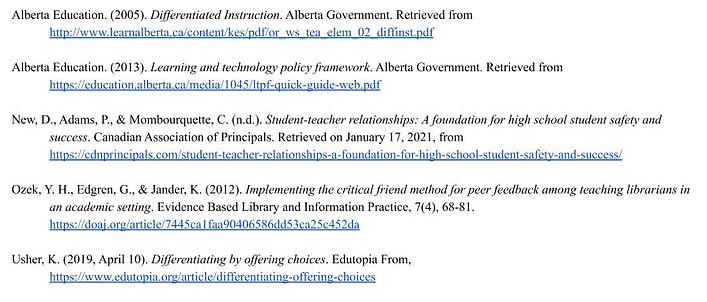
Building meaningful relationships has been a priority in both my personal and professional life. My important relationships have created the foundation for strong support networks, and have contributed toward my successes. Without the encouragement from my supportive relationships, I likely would not have pursued my passion to become a middle school teacher. During Field III, I experienced the benefit that appropriate student-teacher, and teacher-teacher relationships have. After developing professional relationships with each of my classes, I was able to differentiate instruction to use specific instructional, and classroom management, strategies that were effective for the unique needs of my class (Alberta Education, 2005). For example, after asking the students what activities they enjoyed to partake in their free time, I learned that many students loved to play the video game, Among Us. Using this information, I developed a formative assessment for math that incorporated the basics of this game, and was appropriate for students' skill levels, engaging, and meaningful for students (New, Adams, & Mombourquette, n.d.).
During Field, I also had the opportunity to collaborate with experienced teachers to build my professional expertise. Through this interaction I learned how to more effectively apply the theory to practical uses, and I learned how to establish relationships with other members of the school community such as, parents, counselors, and the administrative team. I practiced how to navigate different teacher philosophies, and applied their individual perspectives when I to collaborated with the Grade 6 team to create a unit plan for science.
My vision is to create a student-centered, inclusive, and welcoming classroom that celebrates the diversity of the individuals that learn within it. As my teaching philosophy strengthens, I know that I want to design meaningful and engaging learning opportunities by incorporating student voice and the unique experiences of my students. Doing so will help me develop differentiated instruction that encourages my students to take ownership of their learning (Usher, 2019). Incorporating technology will be an effective tool for creating the classroom that I strive for because the platform allows individuals to share, and create knowledge. Technology opens the door to authentic learning opportunities by helping students develop fundamental competencies such as: critical thinking, managing information, and creatively and innovation (Alberta Education, 2013). Developing strategies about how to effectively embed technology into my classroom is an area that will be my focus for professional growth during my Field IV experience.
By establishing positive and trusting relationships with my peers, I have grown and developed more as a professional educator. During each of my Werklund School of Education courses, I have learned with other pre-service teachers. Collaborating with others provided me with opportunities to consider different perspectives, and challenged me to critically explore and reflect on my assumptions. Looking back on these relationships, I realize that many of the individuals were critical friends because we had a supportive relationships, yet we challenged, and provided each other with constructive criticisms within our profession (Ozek, Edgren, & Jander, 2012, p. 71). As my teaching journey progresses, I am excited to pursue future critical friend relationships that contribute to my professional development, but also, provide me with the opportunity to lend support and an alternate lens to another's teaching journey.
References